Health and social justice
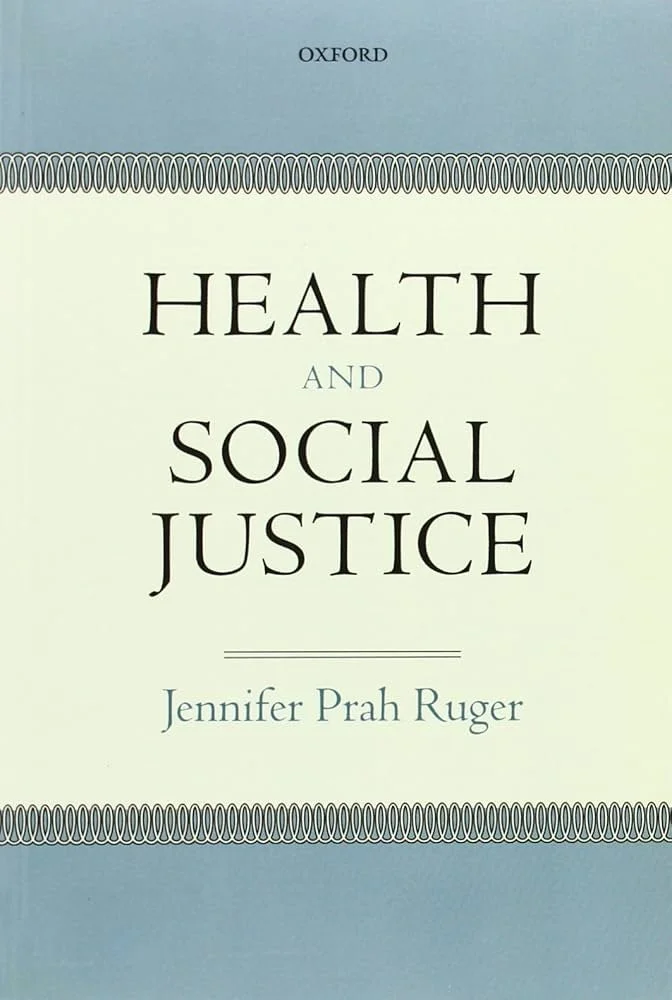
Health and Social Justice provides a theoretical framework for health ethics, public policy and law in which Dr Prah introduces the health capability paradigm, an innovative and unique approach which considers the capability of health as a moral imperative. This book is the culmination of more than a decade and a half of work to develop the health capability paradigm, with a vision of a world where all have the capability to be healthy. This vision is grounded in the Aristotelian view of human flourishing and also Amartya Sen's capability approach. In this new paradigm, not just health care, or even just health alone, but the capability for health itself is a moral imperative, as is ensuring the conditions that allow all individuals the means to achieve central health capabilities.
Key tenets of health capability include health agency, shared health governance, where individuals, providers and institutions work together to create a social system enabling all to be healthy, and the use of theorized agreements and shared reasoning to guide social choice and shape health policy and decision-making. This book provides philosophical justification for the direct moral importance of health and the capability for health and follows a norms-based approach to health promotion. It employs a joint scientific and deliberative approach to guide health system development and reform, and the allocation of scarce health resources. The health capability paradigm integrates both proceduralist and consequentialist approaches to justice, and both moral and political legitimacy are critical.
Endorsement and Review
The book has been endorsed and reviewed by leading economics, philosophy, bioethics, medical, and public health scholars.

Tom L. Beauchamp
Professor of Philosophy and Senior Research Scholar
Kennedy Institute of Ethics, Georgetown University
“Jennifer Prah Ruger has produced a masterpiece--a beautifully written and strikingly bold 'health capability paradigm' for the analysis of problems of health and social justice ... This gem of a book is destined to push forward current debates about health care reform and its theoretical foundations. It will more than contribute to this field of investigation; it will be a defining moment”.

Arthur Caplan
Director of Center for Bioethics and Sidney D. Caplan Chair of Bioethics
University of Pennsylvania
“Ruger articulates a persuasive case ... for grounding reform in a commitment to human flourishing ... [and] presents us with practical tools for determining what to cover and how to allocate resources at a time when cost-containment must be a constraint on future policy. Health and Social Justice is an important book not just as a guide to current debates, but for understanding how to navigate future challenges in the rapidly evolving environment of health policy in the United States and other nations”

Julio Frenk
Dean and T & G Angelopoulos Professor
Harvard School of Public Health
“I have no doubt that this book will become a beacon for the debates on health system reform in the United States and around the world”.

Lawrence O. Gostin (A Bulletin of the World Health Organization review)
O’Neill University Professor
Georgetown University
“In this seminal work, Ruger presents a theory of health and social justice, which she calls the “health capability paradigm” – whereby she says that all people should have access to the means to avoid premature death and preventable morbidity. Hers is a vision that incorporates the philosophical, economic and political to make a compelling case that all societies (through public–private partnerships) can design and build effective institutions and systems to achieve health capabilities”

Su-ming Khoo (International Sociology)
National University of Ireland, Galway
“Ruger’s interdisciplinary and substantive schema moves well beyond theoretical minimalism to elaborate a collective vision for equal access to quality healthcare, taking in problems, surrounding collective norms, individual responsibility and positive health agency”

Joseph P. Newhouse
John D. MacArthur Professor of Health Policy and Management and Director of the Division of Health Policy Research and Education
Harvard University
“[A]n original synthesis ... that illuminates a way forward toward a more rational health policy and health policy process ... [A] must read for all serious students of health policy”

David Orentlicher (Inquiry)
Samuel R Rosen Professor
Indiana University
“Jennifer Prah Ruger provides a valuable contribution to the theoretical literature on the right to health care ... Ruger's central health capabilities ... will resonate widely ... Ruger presses the strengths of her approach, but wisely recognizes its limits ... Readers will benefit from the impressive interdisciplinary nature of Ruger's analysis. The range of her work cuts easily across political philosophy, political science, economics, law, public health, and medical ethics”

Thomas Pogge
Leitner Professor of Philosophy and International Affairs
Yale University
“[A]n attractive, concrete vision of a health society, strongly grounded in philosophy, economics and public health”

Amartya Sen
Thomas W. Lamont University Professor and Professor of Economics and Philosophy, Nobel Prize in Economic Sciences
Harvard University
“Ruger enhances the reach of her powerful perspective by enlightening investigations of human flourishing ... By producing a book of such richness concerning a major area of human agency and policy, Jennifer Prah Ruger has substantially advanced the reach of public reasoning, not just about health care, but about social justice in general”

Kristin Whitehill Bolton (Social Work in Public Health)
University of North Carolina
“In Health and Social Justice, Ruger articulates a theory drawing predominantly from the fields of philosophy, economics, and political science to create a unique paradigm. Ruger’s “health capability paradigm” eloquently illustrates a model capable of eradicating the current barriers to health and social justice … Ruger’s health capability paradigm represents a novel theoretical framework to guide future health care policy … Overall, this book is impressive, as it is well researched and insightful. Ruger’s theory presents a unique integration of disciplines salient to the current health care policy debate. She not only develops a framework capable of resolving health inequality but also presents a descriptive health capability paradigm that could be actually implemented. Her theoretical framework seems effective in rectifying the United States health care system as well as in promising guidelines for other countries … Because Ruger primarily draws from the fields of philosophy, economics, and political science, Health and Social Justice provides students with a sterling look into the way of thinking of other disciplines”

Mario Zangrando(Theoretical Medicine and Bioethics)
Doctors with Africa CUAMM
“Ruger presents a new theoretical model of universal health care. She calls this model “health capability paradigm”: an original synthesis of all these disciplines that illuminates a way forward toward a more rational health policy and health policy process”

CHOICE
“Ruger combines sophisticated philosophy, concrete policy proposals, and astute observations ... With its theoretically sophisticated and realistic policy analysis, this work will be an important read for ethicists, students of health policy, and policy makers“

Harvard Law Review
“In this important book ... Ruger's 'health capability paradigm' builds upon Aristotle's theory of 'human flourishing' with ... insight from diverse fields such as law, politics, and economics ... Those readers with an interest in law will find Professor Ruger's cogent analysis of and respectful counterargument to Professor Eugene Volokh's idea of a 'right to medical self-defense' particularly provocative ... [R]eaders would be wise to heed [her model's] wisdom”

Health and Human Rights
“Jennifer Prah Ruger invites the reader to envision a world where health policy allocated resources such that all persons could realize their maximum capabilities for health. But before such a dream might be realized, Ruger argues, policy makers must pass federal legislation that ensures equity in health. This book … offers an ethical framework for putting this ideal into practice by applying capability theory to health and social justice, with a focus on domestic health care reform. The book’s four sections include: a review of current approaches to public health and medical ethics as they have shaped health policy (part 1), a new theoretical model, the “health capability paradigm” (part 2), discussion on how this new approach and paradigm might be applied to domestic health policy (part 3), and a summary of its relevance for domestic health reform (part 4)”
Journal of ETHICS
"Editor's Choice"
Journal of Health Politics, Policy and Law
“Ruger demonstrates that she has ... thought long and hard about multiple aspects of the ethical, legal, and political environments that impinge on public health and health care policy ... and despite the interdisciplinary breadth of her research, I cannot think of a page of it that is extraneous ... Her HCP is constructed precisely in order to demonstrate what it would mean for policy and in practice to take capabilities earnestly in health policy debates ... the clarity and forcefulness of her argument suggest that hers is a voice worth hearing on a related set of health policy topics not directly tackled in this impressive and wide-ranging volume”

Journal of the American Medical Association
“The thesis of Health and Social Justice is that a new way of discussing health policy and health reform in general (and health care in particular) is needed. The author offers such a new paradigm … this book is not for the reader causally interested in health policy or health reform. Instead, it is meant for those seriously immersed in these issues, providing a different perspective on the meaning of health and the importance of true collaboration on the micro as well as macro levels”

Medicine, Health Care and Philosophy
“Understanding justice in health on the basis of health capabilities ... overcomes some theoretical divides, most importantly those between outcomes and procedures as well as freedom and welfare”
Book Symposium
Health and Social Justice was the subject of a book symposium with articles by eight scholars, Uwe E. Reinhardt, Madison Powers, Ruth Faden, Anita L. Allen, Paul Hunt, Joo-Young Lee, Ruhi Saith, and Keerty Nakray, in the Journal of Human Development and Capabilities.

Anita L. Allen
Henry R. Silverman Professor of Law and Professor of Philosophy and member of the Presidential Commission for the Study of Bioethical Issues
University of Pennsylvania
“A complex, timely, ambitious reflection on moral and political legitimacy in healthcare... [A]n original theoretical framework ... a fresh, systematic, forward-looking paradigm ... Ruger has built 'brick by brick' a serious, provocative comprehensive defense of a progressive, social justice perspective on health and healthcare”


Ruth Faden, Madison Powers
Philip Franklin Wagley Professor of Biomedical Ethics and Director of the Johns Hopkins Berman Institute of Bioethics, Professor of Philosophy and Senior Research Scholar at the Kennedy Institute of Ethics
Johns Hopkins University, Georgetown University
“A subsidiary point that Ruger makes as part of her list of arguments for the focus on capabilities is that this focus incorporates within the account of the ends of political action a prominent role for individual responsibility”


Paul Hunt, Joo-Young Lee
Professor of Law and former UN Special Rapporteur on the right to the highest attainable standard of health, PhD student at the School of Law
University of Essex, UK
“A major contribution to an important, complex and continuing process that examines the theoretical and operational relationships between development, poverty reduction, health and human rights ... [T]he health and human rights communities are enriched by Ruger's (2006) philosophical justification for the right to heath, as well as the health capability paradigm ...We commend Ruger's excellent book”

Keerty Nakray
Queen’s University Belfast, Northern Ireland
“‘Health capability’ is a unique analytical concept proposed by Ruger, which seeks to distinguish between ‘good health policy’ and ‘a policy for good health’”

Uwe E. Reinhardt
James Madison Professor of Political Economy, and Professor of Economics and Public Affairs
Princeton University
“I view Ruger's book as the product of monumental scholarship that undoubtedly makes a significant contribution to future academic research on social ethics in healthcare and to academic courses focused on that subject”

Ruhi Saith
Developing Countries Editorial Consultant
Cochrane Public Health Review Group
“Ruger’s work is a welcome addition and systematically explores in detail the theoretical basis for applying the capability approach as a theory of social justice to health. A reading of the book in the context of the developments in public health highlights the contributions that her work is able to make, amongst other aspects, to the problem of moving from a maximizing to an equity-oriented measure of health”
PANEL

2010 American Public Health Association (APHA) Annual Meeting
The book was the subject of a panel with analysis by four public health scholars, Kirk C. Allison (Director, Program in Human Rights at the University of Minnesota School of Public Health), Bruce Jennings (Adjunct Associate Professor in the Department of Health Policy and the Center for Biomedical Ethics and Society at Vanderbilt University Medical Center), Andrea Lynn Kalfoglou (Associate Professor of Public Health at the University of Maryland, Baltimore County (UMBC)), and Lisa Eckenwiler (Professor and Chair of the Department of Philosophy at George Mason University)

2010 American Society for Bioethics and Humanities (ASBH) Annual Meeting
The book was the subject of a panel stating, “the three leading general ethical theories of public health and healthy policy” stating, “[b]ioethics has never before had at hand three book-length treatments of justice and health” with Just Health by Norman Daniels (Harvard) and Social Justice: The Moral Foundations of Public Health and Health Policy by Madison Powers (Georgetown) and Ruth Faden (Johns Hopkins).